The honest answer: a 1,000-pound round bale lasts about 8–10 days for 3 horses, 5–7 days for 5 beef cows, and 25–35 days for 10 goats — but those numbers shift significantly based on bale weight, feeder type, weather, and whether you're feeding free-choice or restricted. This guide walks through the math for every common small-farm scenario.
The Basic Formula
Round bale duration comes down to one equation:
Bale Duration (days) = Bale Weight × (1 − Waste%) ÷ Total Daily Consumption
Each variable matters:
- Bale weight varies enormously — a "round bale" can weigh anywhere from 400 lbs (small 4×4 grass bale) to 1,500 lbs (large 5×6 alfalfa bale). Most 5×5 grass bales run 800–1,100 lbs.
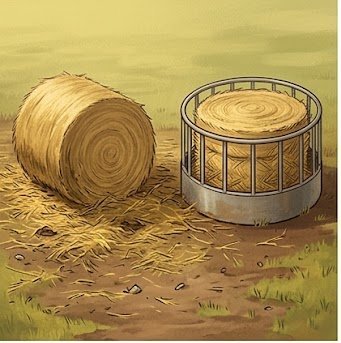
- Waste percentage is the part most people forget. Without a ring feeder, horses waste 35–45% of a round bale. With a slow-feed hay ring, waste drops to 5–15%.
- Daily consumption is based on body weight. Horses need roughly 2% of body weight in forage per day; cattle 2–2.5%; goats and sheep 2–4% depending on size and life stage.
Round Bale Duration for Horses
Horses are the most common reason people search this question. A 1,000-lb horse needs approximately 20 lbs of hay per day at 2% of body weight. That's the baseline — but three things change the real-world number significantly.
Feeder Type Is the Biggest Variable
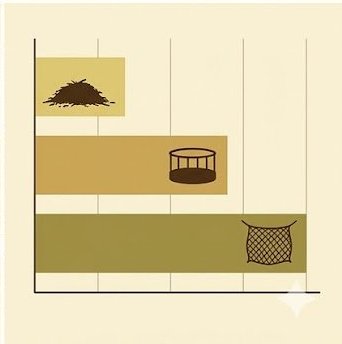
University of Minnesota research found that horses waste up to 57% of a round bale when fed without a feeder — that's more than half your bale on the ground, spoiled or trampled. A properly sized hay ring cuts waste to around 13%. A slow-feed net or ring with a smaller opening gets it under 5%.
| Herd Size | Avg Horse Weight | Daily Consumption | Days (no feeder, ~40% waste) | Days (hay ring, ~15% waste) | Days (slow-feed ring, ~8% waste) |
|---|---|---|---|---|---|
| 1 horse | 1,100 lbs | 22 lbs/day | ~27 days | ~39 days | ~42 days |
| 2 horses | 1,100 lbs each | 44 lbs/day | ~14 days | ~19 days | ~21 days |
| 3 horses | 1,100 lbs each | 66 lbs/day | ~9 days | ~13 days | ~14 days |
| 4 horses | 1,100 lbs each | 88 lbs/day | ~7 days | ~10 days | ~10 days |
| 5 horses | 1,100 lbs each | 110 lbs/day | ~5 days | ~8 days | ~8 days |
Based on a 1,000-lb net bale weight. Adjust proportionally for your actual bale weight.
What About Pony or Mini Horses?
A 400-lb pony needs about 8–10 lbs of hay per day. A round bale lasts a single pony roughly 60–80 days with a hay ring — so ponies often do better with small square bales to prevent spoilage from a bale sitting too long in wet conditions.
Round Bale Duration for Cattle
Beef cattle eat approximately 2–2.5% of their body weight in dry matter per day. A 1,200-lb beef cow needs roughly 26–30 lbs of hay daily during winter when pasture isn't available.
| Herd Size | Avg Cow Weight | Daily Consumption | Days (open feeding, ~25% waste) | Days (ring feeder, ~10% waste) |
|---|---|---|---|---|
| 2 cows | 1,200 lbs each | 56 lbs/day | ~13 days | ~16 days |
| 3 cows | 1,200 lbs each | 84 lbs/day | ~9 days | ~11 days |
| 5 cows | 1,200 lbs each | 140 lbs/day | ~5 days | ~6 days |
| 8 cows | 1,200 lbs each | 224 lbs/day | ~3 days | ~4 days |
| 10 cows | 1,200 lbs each | 280 lbs/day | ~2–3 days | ~3 days |
Cattle waste less hay than horses when using a proper ring feeder — the large muzzle and feeding posture of cattle means they pull and eat more efficiently. The biggest cattle-specific variable is whether cows are pregnant or lactating: a cow in her third trimester of pregnancy needs 15–20% more feed than a dry cow.
Round Bale Duration for Goats
Goats are outliers in the hay world — they are notorious for wasting enormous amounts of hay regardless of feeder type. They paw at it, urinate on it, and refuse to eat anything that touches the ground. A well-designed hay manger (not a cattle ring) is essential.
A typical 100-lb doe needs about 2–3 lbs of hay per day. That sounds small, but 10 goats add up to 20–30 lbs daily.
| Herd Size | Daily Consumption | Days per 800-lb bale (with goat manger) | Days per 1,000-lb bale (with goat manger) |
|---|---|---|---|
| 5 goats | 12–15 lbs/day | ~37–43 days | ~46–54 days |
| 10 goats | 25–30 lbs/day | ~18–22 days | ~23–27 days |
| 15 goats | 37–45 lbs/day | ~12–15 days | ~15–18 days |
| 20 goats | 50–60 lbs/day | ~9–11 days | ~11–13 days |
Round Bale Duration for Sheep
Sheep are more efficient than goats — they waste less and eat more predictably. A 150-lb ewe needs about 3–4 lbs of hay per day in winter.
| Flock Size | Daily Consumption | Days per 800-lb bale | Days per 1,000-lb bale |
|---|---|---|---|
| 5 ewes | 15–20 lbs/day | ~28–37 days | ~35–46 days |
| 10 ewes | 30–40 lbs/day | ~14–18 days | ~18–23 days |
| 20 ewes | 60–80 lbs/day | ~7–9 days | ~9–11 days |
Why Your Bale Might Run Out Faster Than Expected
If your bale is disappearing faster than these tables suggest, one of these is usually the culprit:
- Bale weight was overstated. Ask your hay supplier for actual bale weights, not estimates. A "1,000-pound bale" from a dry year may only weigh 780 lbs. Weigh a bale on a livestock scale if you're buying regularly from the same supplier.
- Dry matter content is low. Hay baled at high moisture contains water weight. A 1,000-lb bale at 20% moisture has less actual nutrition than an 1,000-lb bale at 10% moisture — and animals may eat more to compensate.
- The bale got rained on. Stored improperly, round bales can lose 15–40% of their dry matter to weather. The outside layer becomes inedible, and animals refuse it — raising your "effective waste" dramatically.
- You have a dominant animal hogging the feeder. One aggressive horse or cow keeping others off the bale will cause some animals to under-eat while the dominant animal overeats.
Quick-Use Bale Duration Calculator
🧮 Round Bale Duration Estimator
Practical Takeaways
- Always weigh at least one bale per batch to calibrate your estimates.
- A quality hay ring or slow-feed manger is the single best investment to extend your bale supply.
- Plan on bales being consumed 10–15% faster in deep winter than in fall or early spring.
- If a bale is moldy or heavily weathered on the outside, subtract that unusable material from your bale weight estimate before calculating.
- For winter planning, use the Winter Hay Calculator to translate bale duration into a total seasonal supply estimate.
Recommended Tool: Slow-Feed Hay Net
The single most effective way to extend your bale supply is a slow-feed hay net. University research shows they reduce waste from 33% to under 6% — effectively stretching every bale by nearly 40%. The nets listed below fit 4×4 and 5×5 round bales and hold up through a full winter season.
View Slow-Feed Hay Nets on Amazon → As an Amazon Associate, HayWise earns from qualifying purchases.